
Mark O’Connor’s Journey Continues
By Ross Boissoneau
Few, if any, can boast a career like that of Mark O’Connor. A prodigy on fiddle as a youngster, he won multiple national fiddle, guitar, and mandolin champion titles. He’s recorded nearly 50 albums, been a member of three hugely influential ensembles – the David Grisman Quintet, the Dixie Dregs and Strength In Numbers – and written and/or recorded genre-hopping music with a slew of country, bluegrass, rock and classical stars. Along the way, he’s won three Grammy Awards and been named Musician of the year seven times by the Country Music Association.
Today he’s perhaps revered for his compositions as much as his instrumental ability. That shift started when he stepped out of the group and studio scene to begin his solo career. “My solo career hinged on my ability to compose. It always came down to the writing and if it can translate,” O’Connor says.
Seems to have translated quite well. His recordings for Sony Classical with Yo-Yo Ma, Appalachia Waltz and Appalachian Journey, sold a million CDs, furthering O’Connor’s reputation and gaining him worldwide recognition as a leading proponent of a new American musical idiom. So too with his “Fiddle Concerto.” It became the most-performed violin concerto composed in the last 50 years.
On his own OMAC Records label, the Baltimore Symphony Orchestra recorded his sweeping “Americana Symphony,” while his 9th concerto, “The Improvised Violin Concerto,” was recorded in Boston Symphony Hall. In all, O’Connor’s compositions have received more than 700 performances by orchestra.
That success hasn’t come at the expense of his performing. While tours by the likes of Mannheim Steamroller, the Trans-Siberian Orchestra, Straight No Chaser and others have become holiday traditions, so too has “An Appalachian Christmas.”
“The name of the tour, ‘An Appalachian Christmas,’ is tied to my most famous composition, ‘Appalachia Waltz,’ which I composed for Yo-Yo Ma and recorded with him,” says O’Connor. “Even though our holiday album is called A Christmas Duo, we continue to perform ‘Appalachia Waltz’ on the album and tour, making it a medley with ‘Silent Night.’ The current tour connects to the initial holiday album, and it completes the trilogy of recordings of mine: Appalachia Waltz, An Appalachian Journey and An Appalachian Christmas.”
O’Connor has been doing his Christmas tour for 15 years. “The year after the release of Appalachian Christmas. It was a holiday hit album for me,” says O’Connor. It received plaudits from The New York Times, the Wall Street Journal and others. “The agency suggested I put together a Christmas tour. It was such an attraction that first year we kept going.
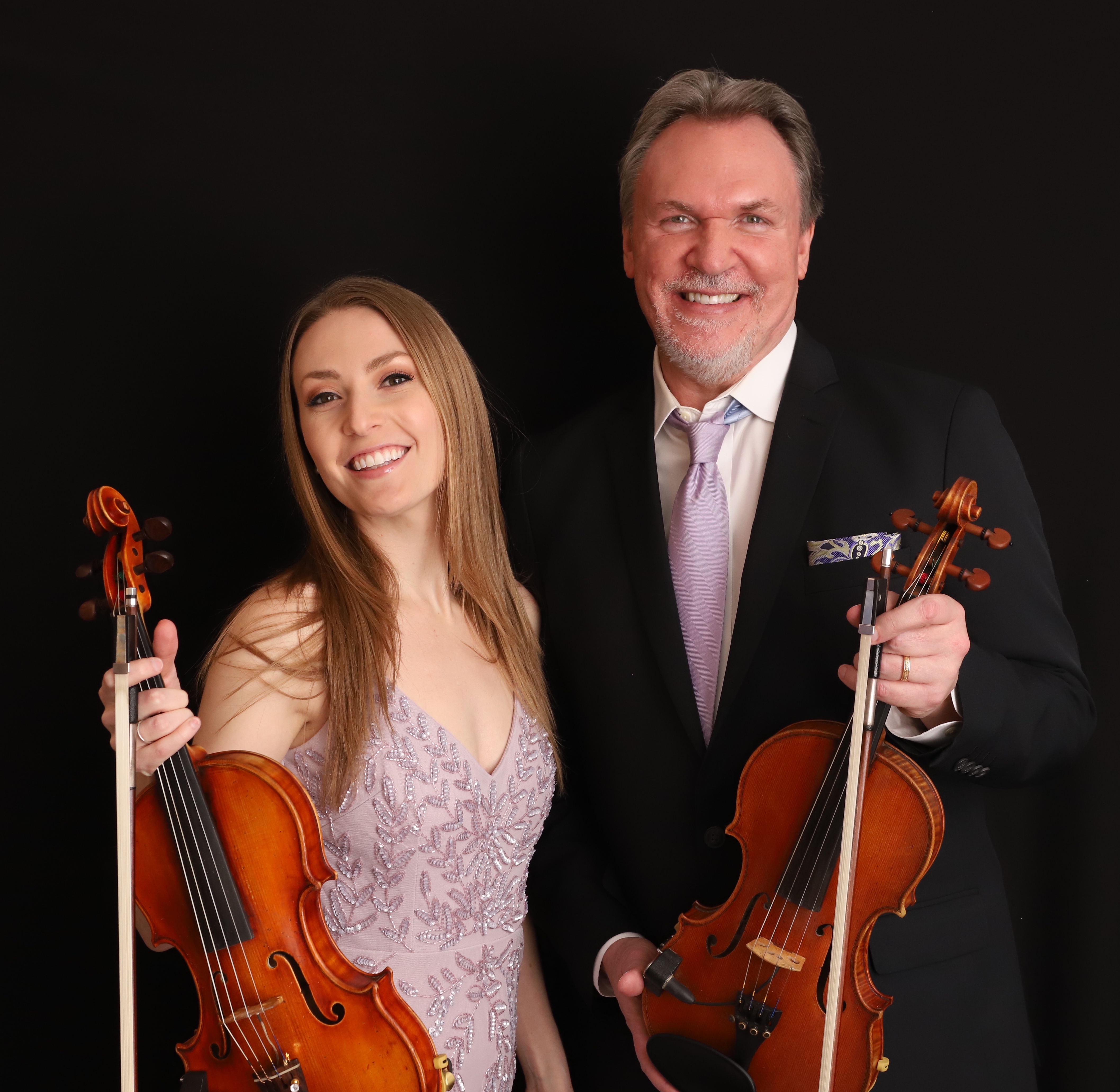
Maggie and Mark
“It changed quite a bit over the years,” O’Connor notes. Indeed, over that decade and a half, the show has morphed from a full band onstage to its current iteration as a duo show, featuring his wife Maggie on violin and vocals and Mark on violin, guitar, mandolin and vocals.
The shift was engendered in part by the pandemic. “We did a remote show with Maggie and I. We did new arrangements that Maggie and I could handle,” O’Connor explains. They discovered that the sound of the two of them was more transparent and the bulk of the set could indeed translate to the duo setting. It also meant there were fewer instances of getting in one another’s way in the larger ensemble. “Physically we couldn’t keep up with all the instruments overplaying.”
It also brought him back to other instruments he had played, before setting them aside to concentrate on violin and composition. “At some point during the O’Connor band (which also included Mark’s son Forrest and daughter -in-law Kate Lee), I was around guitar and mandolin. I’d try licks. I started to miss it.”
It all led to incorporating some guitar and mandolin into the live duo show with Maggie. “It went great musically. The reception was even more than could have been predicted, and even better than the bluegrass ensemble,” he says.
This year’s 2026 tour includes dates on the East Coast, the West and the South as he zig-zags across the country: Washington D.C. and North Carolina to Arizona, Florida to Washington and Oregon, Indiana and Georgia (for a complete list of dates, go to markoconnor.com).
O’Connor has long been an endorser of D’Addario strings for his guitars and mandolins, but he preferred other strings for his violin. “I’d been with D’Addario since Grisman (he joined David Grisman’s quintet in 1979 at age 17). I always used them and always loved them.
“In Nashville in the 80s, D’Addario decided to move into the violin and string market, and wanted me to be their chief tester. I’d already established my sound in Nashville sessions. The two different violin strings I used before D’Addario were Jargar and Prim.” So he told D’Addario, if the company make a string that provided him the sound he wanted, he would switch. “Eventually I said, ‘I’ll take it.’ That was the mid-80s. I’ve been using D’Addario violin strings ever since.”
Mark Specifically plays these strings sets on his instruments:
Violin: D’Addario Helicore H310 Stranded Steel Core, Heavy Tension
Guitar: D’Addario Phosphor Bronze EJ17 Medium Gauge .013 – .056
Mandolin: D’Addario Coated Phosphor Bronze XSM1140 Medium Gauge .011 – .040
Ross Boissoneau is a regular contributor to Something Else! Reviews, Northern Express and Local Spins. He’s written for the All Music Guide, Jazziz and Progression Magazines, and is a member of the Downbeat Critics Poll.
