
Young Taiwanese Musician Bringing Ukulele To The Masses
By Ross Boissoneau
Born in 2007 in Taiwan, Feng E began playing ukulele after piano lessons failed to take. He did have a bit of an excuse, as he was only 4 when he started piano. He was only 5 when he turned to the diminutive four-stringed instrument, but with encouragement from his dad he began a lifelong love affair with the uke. Today he boasts over 600,000 YouTube subscribers and millions of views on the social media channel.
He owes it all to his kindergarten teacher, who noticed that his finger development was slow. He couldn’t draw a straight line or form a ball out of clay. Upon the recommendation of the teacher, his father urged him to play the piano, but the youngster lacked both interest and aptitude. “My father actually felt it was a regret in his own childhood not to have studied piano and built a solid musical foundation, so he wanted me to learn,” Feng E says.
When his father then introduced him to the ukulele, he also resisted. But his resourceful dad eventually found a way to convince him to practice: he offered to play Legos with him after each lesson.

Feng E
Only 13 years later, Feng E has become a star in the world of ukulele music, performing and winning competitions around the world, from Singapore, Malaysia, Japan and China to Hawaii. In 2017, he was the only competitor on Asia’s Got Talent to get the Golden Buzzer from producer David Foster. In 2018, a video of Feng E playing Tommy Emmanuel’s arrangement of “Classical Gas” by Mason Williams went viral (the treat at the bottom of this article), and he was invited to perform on The Ellen DeGeneres Show. In 2020, Feng E made it to the quarter-finals of America’s Got Talent.
Today the 18-year-old performs his arrangements of popular tunes and original compositions to audiences across the globe. Typically, his shows are solo ukulele affairs, though he’s comfortable playing with other musicians. He also continues to build his worldwide audience via social media, and the number of his plays on YouTube continues to grow.
With his busy schedule and the fact he lives halfway around the world, the easiest way to conduct an interview was via email. He answered questions as below:
SBM: Why did the ukulele appeal to you more?
Feng E: It’s small, but it holds incredible musical potential.
SBM: And why does the ukulele still appeal to you now?
Feng E: Because it pushes me to be creative within a limited tonal range. There’s also the challenge of shaping a melody before the very short sustain fades away, which I find exciting.
SBM: Is your family musical?
Feng E: Not exactly. My father is a cinematographer and my mother is a nurse.
SBM: Besides piano and ukulele, what other instruments do you play?
Feng E: Acoustic guitar, electric guitar, and more recently I’ve been exploring analog synthesizers.
SBM: Why did you choose to tour instead of just posting videos on YouTube or other platforms?
Feng E: There are times when the impact of music simply can’t be transmitted online. The live experience is still something very special, and it can’t really be replaced.
SBM: Do you prefer rearranging familiar music for listeners, or writing your own?
Feng E: I enjoy writing my own songs. I’ve already finished the material for my next album, which is currently in production, and I’ll be bringing those songs with me on tour.
SBM: What are your goals, musically and otherwise?
Feng E: To make an album I’m truly proud of and to create performances that I genuinely love.
SBM: What instruments work well alongside the ukulele?
Feng E: I’ve played with all kinds of instruments—from rock bands to string ensembles to traditional Asian instruments. Because of its bright high frequencies and dynamic attack, the ukulele often cuts through and takes the lead in those settings.
SBM: Do you collaborate with other musicians, or do you mainly perform solo?
Feng E: Both. I formed a math-rock band in Taiwan, and I’ve recorded ukulele accompaniments for a number of singers. But I also love playing solo, and that’s what I’ll be bringing on tour in the U.S.—a powerful solo ukulele performance.
SBM: What kind of ukulele do you play?
Feng E: The Enya Feng E e6 signature model. It’s the result of a long collaboration with Enya and is designed to meet all my needs on stage—from feel to pickup configuration to the wood itself. Everything about it is exactly what I want for live performance.
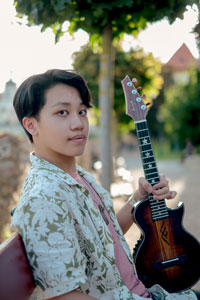
Feng E
SBM: What kind of wood is your instrument made of?
Feng E: It has a koa top, with a maple body and neck, and an ebony fretboard.
SBM: Can you explain why you chose that combination?
Feng E: I love the midrange of koa, but I don’t like the typical all-koa setup that’s so common on ukuleles—it often sounds too muddy and boomy. That’s why I chose to balance it with maple.
SBM: What strings do you use?
Feng E: Ernie Ball! They’re the best.
SBM: Why not switch to guitar now that you’ve grown and your hands are bigger?
Feng E: I actually do play both acoustic and electric guitar in addition to the ukulele.
SBM: What does a typical day look like for you?
Feng E: After finishing projects like arranging, songwriting, or recording, I usually work on my own ideas. Sometimes I’ll practice new techniques I’ve been experimenting with.
SBM: Why should someone come see your show?
Feng E: It’s rare to see such a refined ukulele performance. (Though maybe I shouldn’t be the one saying that!)
SBM: In some of your videos, when you play in the park, people around you don’t seem to react. Is that a cultural thing?
Feng E: Yes—people in Taiwan tend to be more shy, sometimes even a little indifferent.
SBM: What kind of music do you listen to? Who are some of your favorite artists, and why?
Feng E: I listen to all kinds of music, but recently I’ve especially been into Julian Lage and GoGo Penguin.
SBM: Where do you see yourself and your music in 5 to 10 years?
Feng E: I want to be a performer as successful as Tommy Emmanuel, have a great band of my own, and also create film scores for projects I love.
Ross Boissoneau is a regular contributor to Something Else! Reviews, Northern Express and Local Spins. He’s written for the All Music Guide, Jazziz and Progression Magazines, and is a member of the Downbeat Critics Poll.
