
How to Use a Capo: A Beginner’s Guide to Guitar Capos
What is a Capo? A Beginner’s Guide to Unlocking Your Guitar
Sometimes, playing a song you like and finding the vocal range is too high or not being comfortable with barre chords, can get in the way of your guitar playing enjoyment. A capo can simplify and avoid barre chords and complex chord shapes or bring a song into your best vocal range. Here we will learn what a capo is, how it works, and how you can use it to learn new techniques and solve troubleshoot common issues. It can also be used to change the character of an instrument’s tone, usually creating a lighter, more delicate sound.
Capo Meaning, Function, and History
The word “capo” is short for the Italian term capotasto: (capo = head, tasto = key/fingerboard). The device literally creates a new, temporary “nut” on a specific fret of your guitar.
A Movable Nut
The metal or plastic piece at the top of the neck, the nut, is what defines the length of the vibrating strings. A capo can be moved up and down the neck, shortening the vibrating length of all open strings simultaneously.
What is a Guitar Capo?
How It Works
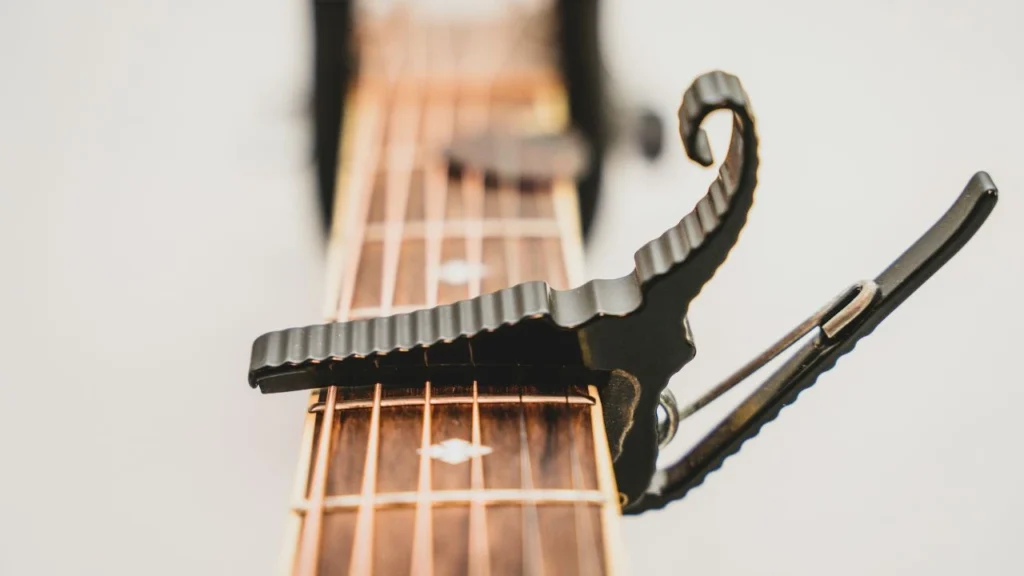
The capo tightly presses down all six (or twelve) strings against the fretboard at a selected fret. The capo transposes the music for you, all while allowing you to play the chords you already know.
A Quick History: From Capotasto to Modern Marvel
An old-time capo was used on lutes and other stringed instruments in the late 1700s. The 19th and 20th centuries saw the invention of metal clamps and spring-loaded capo designs. Today, highly engineered capos ensure perfect intonation.
What Does a Guitar Capo Do?
Guitarists can avoid playing barre chords, which require significant finger strength and precision.
A capo can also help you:
- Easily raise or lower the song’s key until it sits perfectly in your singing voice’s sweet spot.
- Add brightness and texture that can’t be replicated with open chords in standard tuning.
- Use your preferred open-chord voicings while playing in a key that works for everyone, while collaborating with other musicians.
How to Use a Capo
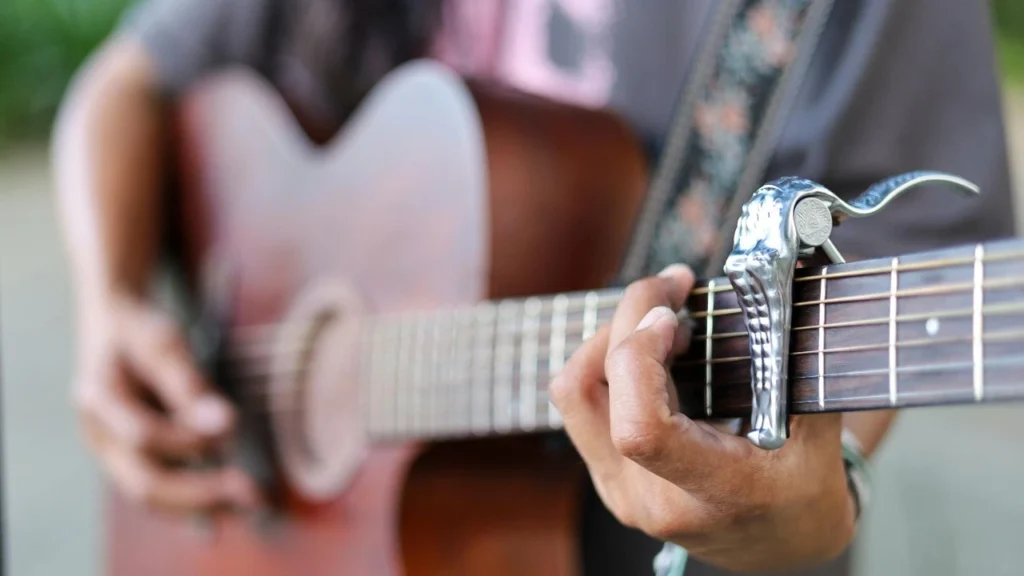
Proper placement is the most important factor.
Where to Place a Capo
Place it right behind the desired fret wire, as close to it as possible, without sitting on top of it. Don’t place it in the middle of the fret space; the strings will likely buzz.
How to put a capo on your guitar:
- Decide which fret you need to place the capo on for your desired key. Consult a guitar capo chart to aid in that decision.
- Squeeze, unlatch, or unscrew it to open the clamp.
- Position the bottom bar or strap on the underside of the neck and bring the top bar down just behind the metal fret wire.
- Release the mechanism to clamp the strings firmly to the fret or clip the strap closed.
- Strum the strings and use a tuner to ensure the pitch is correct.
A Guide to the Different Types of Capos
| Capo Type | How it Works | Pros | Cons | Best For | Popular Brands |
| Trigger/Spring | Squeeze/release to open/close. Spring tension holds it in place. | Very fast to move; one-handed operation. | Tension can be too high; may pull strings sharply. | Live performance, quick key changes. | Kyser, Dunlop, Planet Waves |
| Screw-Tension | A screw mechanism tightens/loosens the bar. | Adjustable tension for perfect intonation; low profile. | Slower to move; two hands required. | Studio work, delicate instruments, precise tuning. | Shubb |
| Cradle/Yoke | Wraps around the neck; tension adjusted with a screw. | Best intonation and tuning stability; very low profile. | Slowest to move; must be put on/taken off by loosening or tightening the thumb screw significantly and closing or opening the lock/latch. | High-end guitars, permanent placement, recording. | Paige, Shubb |
| Toggle/Strap | A strap or fabric band with a tension-adjusting buckle/toggle. | Very inexpensive; lightweight; good for classical guitars. | Tension can be inconsistent; less durable than metal. | Beginners, classical guitars, budget-conscious. | Dunlop |
Specialty Capos for the Adventurous Player
Partial capos only clamp down on a few strings. A rolling capo is a wheeled device that you can physically roll up and down the fretboard.
How to Find The Right Capo for Your Guitar
Check the points below, or contact Strings by Mail for assistance.
Fretboard Radius
Note the attributes below:
- Acoustic/Electric Steel-String: Use a curved trigger-style capo like a Kyser Quick-Change Capo or a screw-tension Shubb Cap.
- Classical Guitar: You need a capo with a flat clamping surface, like the Shubb C7G.
- 12-String Guitars: These require specific capos with a different pressure pad design.
Creative Capo Techniques to Inspire You
The capo is a serious creative tool. Many great guitarists use capos.
Famous Songs, Famous Riffs
- “Here Comes the Sun” (The Beatles): It features a capo on the 7th fret, for a bright, mandolin-like sound.
- “Hotel California” (Eagles): The intro uses a capo on the 7th fret.
- “Wonderwall” (Oasis): It uses a capo on the 2nd fret to avoid a difficult F# major barre chord.
Partial Capoing for “Alternate Tunings”
Clamp certain strings to create drones and unexpected harmonies.
High-Voicing for Texture
Place a capo high on the neck (fret 7 or higher) for a bright, sparkling texture.
Troubleshooting Common Capo Problems
My guitar goes out of tune!
This is often caused by having a capo with too much tension.
- Solution: Reposition the capo closer to the fret, or use a screw-tension model. You also may need to “retune” a bit to get it just right
I hear a buzzing or rattling sound.
The strings aren’t clamped firmly enough to make clean contact with the fret wire.
- Solution: Ensure the capo is right behind the fret. If it’s adjustable, increase the tension slightly.
Can a capo damage my guitar?
It is not common, but it may happen if you use a capo that is the wrong fit, or by storing it clamped to the headstock or neck for extended periods.
Shop Strings by Mail for Quality Capos and More Guitar Accessories
Strings by Mail offers a variety of capos from top brands including D’Addario, SpiderCapo, Shubb, Dunlop and others. Not sure which to choose? If you need assistance, we’d be happy to help. Please contact us (231-421-3773) or call toll-free in the USA: 1-800-513-8271. You may also contact us online.
FAQs
Does using a capo affect the guitar neck?
It usually won’t cause permanent damage or warp your guitar’s neck, but it’s best to remove it when not using it.
What fret is the key of C if I use a G-shape chord?
Place the capo on the 5th fret; playing a G chord shape will produce a C major chord. This is a crucial entry in a beginner full capo chart.
What fret is the key of G if I use a D-shape chord?
Place your capo on the 5th fret. This shows what capo is the key of g.
Why do my strings buzz when I use a capo?
Buzzing comes from incorrect placement in the middle of a fret space instead of right behind the fret wire, unless you are using a particularly old capo that is worn unevenly.
Do I need a different capo for my electric and acoustic guitars?
Acoustic and electric guitars often have different fretboard radii. Many capos are designed to work on either acoustic or electric guitars, but some are specifically designed for only one neck type. For best results use a capo designed for the specific curvature of your fretboard.
Classical and flamenco guitars use a different capo than electric and acoustic guitars.
What is the purpose of a capo?
It’s for raising the pitch of the open strings, so you can play in different keys and for using familiar open-position chord shapes.
Does using a capo change the key?
Placing a capo raises the pitch of all open strings, transposing the song’s key, while using the original chord fingerings.