
How to Play an F Chord on the Guitar: A Step-by-Step Guide
The F major chord is often called the “progress-stopper.” For many beginners, it is the first real wall they hit in their musical journey.
It can feel like your fingers simply aren’t long or strong enough. With the right technique, it becomes just another tool in your kit. This guide provides a progressive method to master this shape.
What Is an F Chord?
Here’s what an F chord is in a musical context.
The F major chord consists of three notes: F (the root), A (the third), and C (the fifth). Mastering this chord opens the door to the entire fretboard. Because it is a movable shape, learning F means you can eventually play the barre forms up the neck of G, A, and B chords, too.
Easy Ways to Play an F Chord on the Guitar
There are several ways to voice this chord, depending on your skill level.
The Three-String “Easy F”
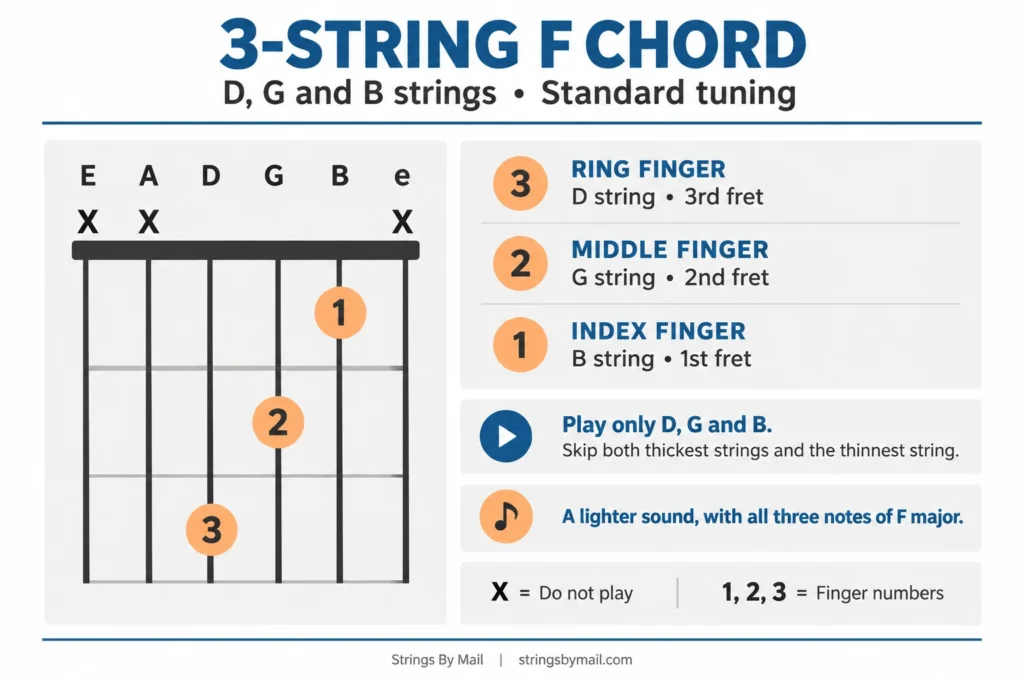
This version is perfect for absolute beginners.
Place your ring finger on the 3rd fret of the D string. Place your middle finger on the 2nd fret of the G string.
Then, put your index finger on the 1st fret of the B string. Strike only 3 of the bottom four strings (D, G, and B).
This version sounds thin, but it is harmonic accuracy. It allows you to keep playing songs while you build finger strength for larger shapes.
You can also play an Fmaj7 by leaving the high E string open and striking that string as well. It has a dreamy, jazzy sound that is much easier on the hands.
The Four-String F
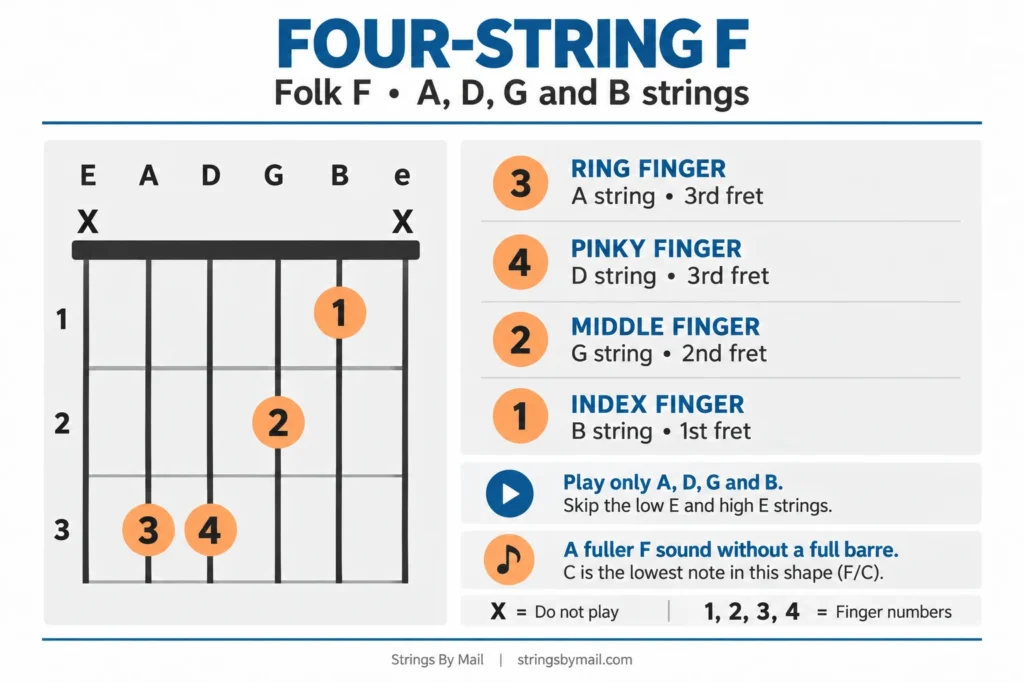
This is often called the “Folk F.” It adds a bit more low-end punch to the chord without requiring a full barre.
Keep your fingers in the “Easy F” position. Move your ring finger to the 3rd fret of the A string.
Put your pinky on the 3rd fret of the D string. This provides a much fuller, resonant sound that fits well in acoustic music.
You can also play this version as an Fmaj7 by leaving the high E string open and striking all strings except the low e (6th). It has a dreamy, jazzy sound that is much easier on the hands.
The Mini-Barre
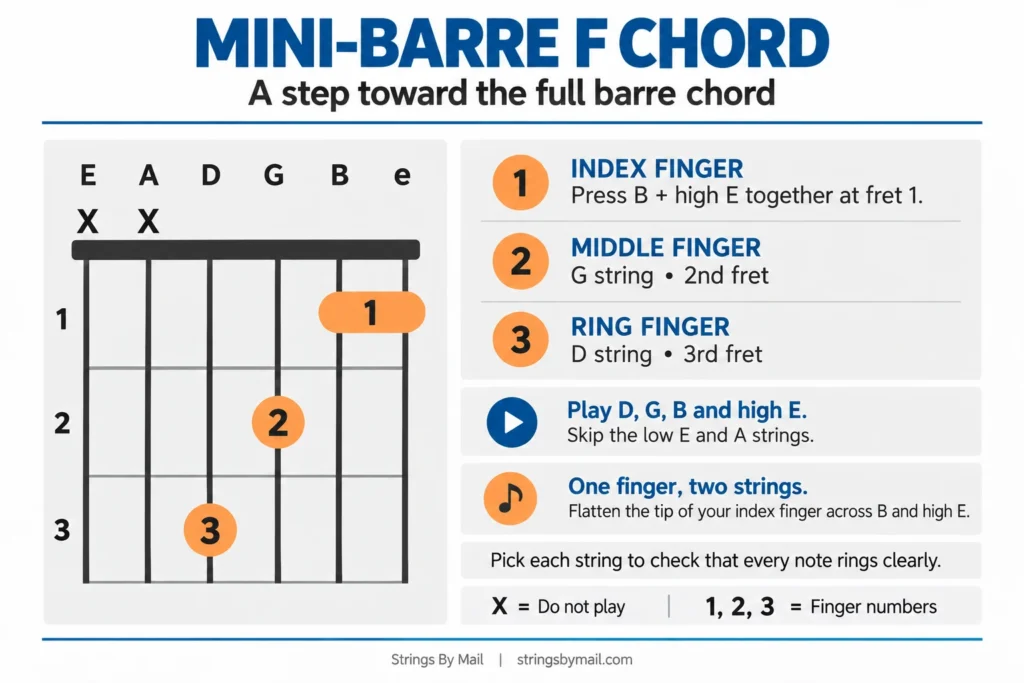
This is the bridge between beginner shapes and the full barre chord. Use your index finger to press down both the B and high E strings at the 1st fret simultaneously.
This requires a slight “roll” of the index finger. It builds the specific muscle memory needed for the full six-string version later.
The Full Barre F Chord
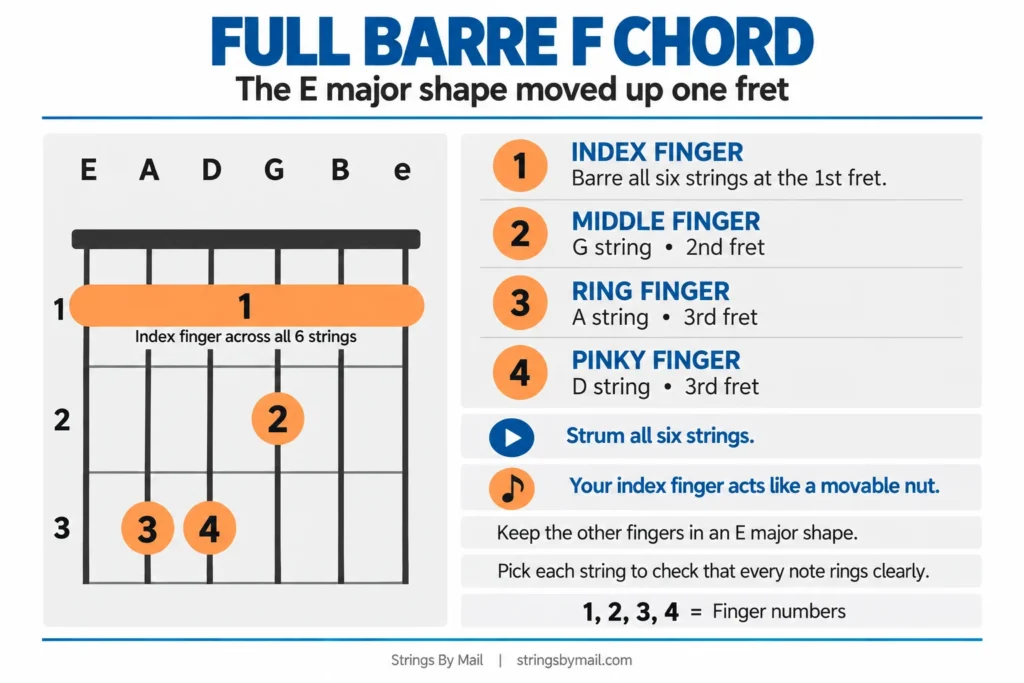
To play the full version, place your index finger across all strings at the 1st fret. This acts like a “movable nut” for the guitar.
Position your middle finger on the 2nd fret of the G string. Place your ring finger on the 3rd fret of the A string.
Place your pinky on the 3rd fret of the D string. This is essentially an “E Major” shape moved up one fret.
The Art of the Barre
Success with the barre chord isn’t about raw strength. It is about physics and leverage.
Tip 1: Your Index Finger is a Tool, Not a C-Clamp.
Avoid using the soft, fleshy underside of your finger. Instead, roll your finger slightly onto its bony side.
Keep your finger as close to the metal fret wire as possible. This reduces the amount of pressure required to get a clean note.
Tip 2: Your Thumb is Your Anchor.
Your thumb should be centered on the back of the neck, roughly behind your middle finger. Avoid “hooking” it over the top for now.
This “pincher” position provides the necessary leverage. It allows your fingers to arch properly over the strings.
Tip 3: Middle Strings Are Already Fretted
Only the 6th, 2nd, and 1st strings need to be fretted by the barre, so you can relax the middle of the 1st finger to some degree, creating a bit of an arch shape in the finger. This makes the barre easier to use.
Tip 4: The Secret Weapon: Your Wrist and Arm.
Don’t rely solely on a “death grip” from your hand. Keep your wrist relatively straight to avoid strain.
Allow the weight of your arm to fall against the neck and allow a gentle backward pressure from your arm. Pulling the guitar slightly toward your body helps press the strings down.
How To Fine Tune Your F Chord
Even with the right shape, the F chord can sound muffled or buzzy.
F Chord Learning Guide Checklist
| Symptom | Likely Cause | Solution |
| High E string is muted | Softer index finger flesh is pressing it | Roll index finger onto the bony side |
| G string sounds buzzy | Middle finger is too far from fret | Move finger closer to the metal fret wire |
| Hand cramps quickly | Squeezing too hard with thumb | Use arm weight to fall into the neck |
| D or A string is dull | Pinky or ring finger is flat | Arch your fingers to apply the firmer tip of the fingers to the strings |
Your Guitar Can Be Your Best Friend (or Your Worst Enemy)
Sometimes the problem isn’t your hands; it’s the instrument itself or the strings.
Guitar String Gauge and Type Matter
Lighter strings require less tension to press against the fret.
For acoustic players, “Extra Light” strings can make barre chords feel significantly easier. Electric players might try a set of .009s.
The Importance of a Good “Setup”
The “action” means the height of the strings located above the fretboard. High action makes the F chord nearly impossible to play.
A professional setup from a local shop can lower the action.
The Importance of a Good Guitar Neck and Body Alignment
If the neck is warped forward or the face of the guitar is collapsing down, the action may be too high to be correctly adjusted
Electric vs. Acoustic: A Tale of Two Tensions
Electric guitars typically have thinner necks and lower string tension. This makes them the ideal place to practice how to play F chord on guitar.
If you find the F chord impossible on your acoustic, try it on an electric first.
Putting It All Together: Practice That Works
Consistency is important; five minutes a day is better than an hour once a week.
Start by slowly and carefully applying the F chord, then slowly and carefully switch between a C major and an Easy F chord.
Once that is comfortable and easy to do, then try “The One-Minute Chord Change.” Set a timer and work over time to increase how many times you can switch between a C major and an Easy F chord.
If a string is muted, stop, adjust your finger, and try again.
Here are a few simple songs to practice your F chord:
- “House of the Rising Sun” (The Animals)
- “Bad Moon Rising” (CCR)
- “Let It Be” (The Beatles)
Shop Strings by Mail for All Your Guitar Supplies & Accessories
You’ll find many guitar instructional books and tips for guitarists on our website, and we’re always happy to help you select instruments, sheet music, strings and accessories, too. You can rely on Strings by Mail for all your guitar needs.
How To Play F Chord on the Guitar FAQs
How long should it take to learn the F chord?
Most players take two to four weeks of daily practice.
My hand hurts when I practice. What should I do?
Stop immediately, take a break and stretch gently. Pain is a sign of too much tension; focus on using leverage. You may need to spend less time at a sitting using the F chord
How do you cheat an F chord on guitar?
Use the “Easy F” version by only playing the 1st, 2nd, and 3rd frets on three of the top four strings, 2nd, 3rd, and 4th. Include the open 1st string to get an Fmaj7th chord
What is the easiest way to play an F chord on guitar?
Try the three-string version: 3rd fret (D), 2nd fret (G), and 1st fret (B).
Do I really need to learn the full barre chord?
No, but is had advantages, so you will be better off learning it eventually. It is a shape that allows you to play a block version of almost any major chord anywhere on the neck.
Why does my F chord sound terrible on my acoustic but fine on my electric?
Acoustic guitars have higher string tension, higher action and thicker strings, making them much harder to press down.
What are the best strings for making barre chords easier?
Look for “Extra Light” gauge strings or “Silk and Steel” varieties for an acoustic guitar and a .09 gauge set for electric guitars.
Once I learn F, what barre chord should I learn next?
Learn the B minor chord. It uses the “A minor shape” barre and is the next most common hurdle for guitarists.
Are F and F major the same?
Yes, in music theory and guitar charts, “F” always refers to the F major triad, unless specified as minor.