
TECLA - Giuliani
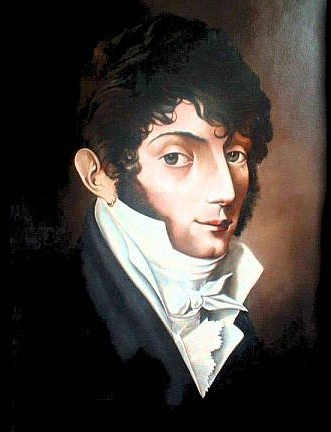
Mauro Giuliani, guitar virtuoso, heir to the lutenists of old, friend of Beethoven and Rossini, composed guitar solos and duets.and also concerti, chamber music, and songs.
Please note that this section, that is to say all the Giuliani works which we offer, is not in order of opus number. To find a Giuliani work by its opus number please go either to the section Giuliani guitar solos pdfs or to the section Giuliani guitar duet pdfs or to the section Giuliani guitar etudes pdfs, all of which are in order of opus number.
Here in Tecla we publish the following works by Giuliani:
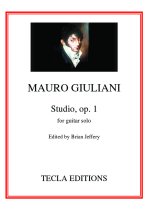
TECLA 0105: The Complete Studies for Guitar
TECLA 2536: 24 Exercises op. 48 for guitar
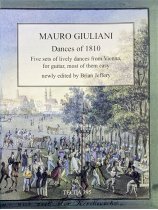
TECLA 0395: Dances of 1810, which is a book of easy dances for guitar which Giuliani composed when he first arrived in Vienna
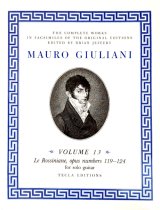
TECLA 0813: The complete Rossiniane, which is a book containing all six of Giuliani's Rossiniane
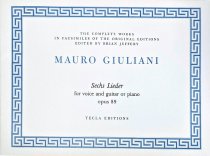
TECLA 0583: Sechs Lieder, a book of six songs in German
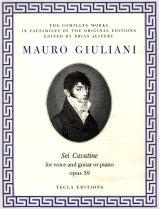
TECLA 0527: Sei Cavatine, a book of six songs in Italian
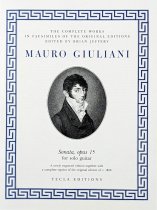
TECLA 0497: Sonata op. 15 for solo guitar
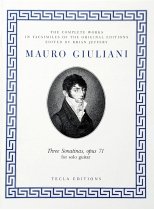
TECLA 0564: Three Sonatinas op. 71 for solo guitar
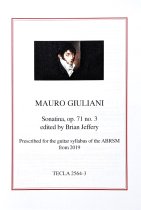
TECLA 2564-3: Sonatina op. 71 no. 3 for solo guitar, re-engraved
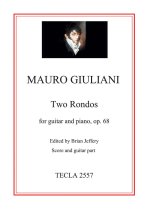
TECLA 2557: Two Rondos op. 68 for guitar and keyboard
TECLA 0633: Gran Sonata Eroica op. 150 for solo guitar
Mauro Giuliani was born in Bisceglie, a small town on the Adriatic coast of Italy not far from Bari, in 1781. In about 1806 he arrived in Vienna and immediately made a huge impression as a guitar virtuoso, composing and publishing there his first and most famous guitar concerto and many other works. A witness who heard him play at this time wrote: “he played so perfectly that he frequently called to mind the marvellous old era of genuine lute-playing”.
I think that those words give a clue to approaching this music in terms of the lighter early 19th century instrument, with its clear sound and lower string tension: virtuoso playing with cascades of notes on the upper strings and lyrical passages on the lower ones: brilliant and dazzling music. Of course today's instrument can play Giuliani's music, but today's instrument has greater weight and greater string tension. I used to play this music often on a Lacote of about 1830, with gut strings and without nails, and I can testify to the greater flexibility and immediate response which it offered.
What is Giuliani's achievement as a composer? It falls into several periods. First are the virtuoso pieces of the time when he had first arrived, from about 1808 to 1812. Then (without a clear break) the period of consolidation in Vienna when he composed hundreds of pieces, his second and third concertos and many songs and pieces for guitar and flute or violin. Finally, the music composed after he left Vienna for Italy in 1819. Let us look at these in turn.
I am writing this piece as the editor of all of Giuliani's music - and I mean all, without exception. Back in 1981-83 I did extensive bibliographical work starting from Thomas Heck's invaluable Yale thesis The Birth of the Classic Guitar (1970). I obtained copies of all the early editions (and that means many, many thousands of pages of them). Librarians all over the world were tremendously helpful. Some copies came even from the then Yugoslavia. Some arrived soaked in the rain (unprotected alas by the British Post Office). I sorted out which editions were the primary sources. There were a good many additions to Heck. I then published all Giuliani's music, every piece with new bibliographical notes establishing the original text and often giving lists of suggestions for performance - while making absolutely clear that any such lists were only a starting point for performers.
First, Giuliani's early and virtuoso period. He composed a Sonata for solo guitar, op. 15; his first concerto, op. 30; and his Studio for the guitar op. 1, a tutor which was much prized, whose right and left hand exercises have never ceased to be used since that time and which is available today as part of the Tecla edition of Giuliani's Complete Studies.
After that brilliant beginning, Giuliani settled down to composing steadily for many years in Vienna. He moved in the thick of Viennese musical society: Beethoven, Hummel, Mayseder, etc. He played (apparently the cello) in Beethoven's Seventh Symphony in 1814. There is no sharp dividing line between the first period and this one, but one could say that this second period has two characteristics. First, it is a consolidation: an achievement which established Giuliani as the principal guitarist in Vienna and one with a serious and solid reputation. Secondly, it established him as an all-round musician, as a composer not only for the guitar but for guitar and flute or violin, guitar and voice, as well as two more guitar concertos.
During all this time, he had Italian influence on his music. Now in 1819 he left Vienna for Italy, first to Venice. In this later period he composed some fine works. Particularly strong was the influence of Rossini. There are his Rossiniane, which are fine potpourris based on themes from Rossini, and splendid arrangements for two guitars of overtures to Rossini operas. Others are strongly Italian as well, such as the Potpourri Nazionale Romano op. 108 or the Variations on Neapolitan folksongs opp. 140 etc. These later works are not often played today but would repay attention.
I come back to the question: what is Giuliani's achievement? It's more than just historical: this is tremendous, virtuoso music. Personally, I hear something akin to a fortepiano played with great energy, lightness and musicality: nothing heavy at all. Surely the Dutchman had the right insight when he wrote that this musician recalled to him the lutenists who had gone before.
-Brian Jeffery
Have a question about TECLA EDITIONS - Giuliani? Just call 800-513-8271 to talk with our friendly music, strings, & gear experts. They’re available Monday-Friday from 9 a.m.-3 p.m. EST. You also can email us.
And remember: All U.S. orders and International orders via USPS, Fed Ex and UPS received weekdays before 3 p.m. EST ship the same day!
International Priority Airmail orders received by 8:00 am EST Tuesday-Friday ship that same day.